.png)
Enhancing Workforce Efficiency Through Coaching and Training
Introduction
For decades, developing employee capabilities has been—and continues to be—a critical driver of success and excellence in today’s fast-paced business environment. Its benefits go far beyond improving individual skills; they extend to enhancing overall team effectiveness,increasing job satisfaction and organizational loyalty, fostering creativity and innovation, and strengthening competitive advantage. Accordingly, investing in workforce capability development is, in essence, an investment in the organization’s future.
This article provides an in-depth overview of workforce development and its broader organizational impact.
Training and Capability Development
Employee capability development is a continuous process aimed at improving organizational performance by enhancing employees’ personal and professional competencies. This process is not limited to academic education or job-specific training; it also includes personal development and life skills enhancement. Such capabilities enable employees to adapt to rapid market changes and meet the increasingly complex demands of competition into day’s business landscape.
Workforce development is a two-way process: employees are responsible for developing their skills and competencies, while organizations are responsible for providing the necessary opportunities,resources, and enabling environment. A deep understanding of this concept allows organizations to design effective training and coaching programs that address both organizational and employee needs, delivering multiple benefits,including:
- Improved performance and productivity
- Higher job satisfaction and employee loyalty
- Reduced employee turnover
- Increased innovation and creativity
- Lower operational costs
- Enhanced competitive advantage
Coaching
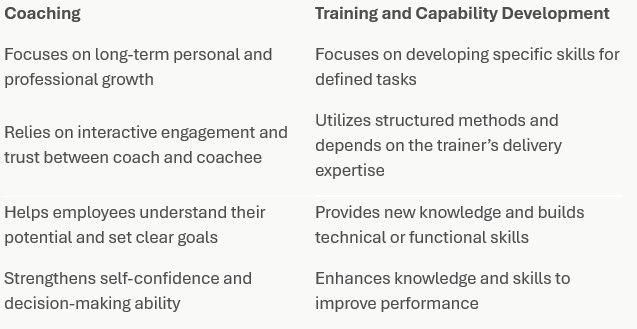
Coaching represents a critical dimension of employee development, offering a more personalized and interactive approach compared to traditional training. It focuses on supporting employees in defining and achieving their professional and personal goals through continuous, tailored guidance.
Coaching is not only a tool for developing professional capabilities; it is also a powerful mechanism for building positive workplace relationships and fostering a culture of support and collaboration. In the following section, we discuss how training and coaching can be embedded within organizational culture and how leadership can actively support these efforts.
Distinguishing Between Coaching and Training
Integrating Training and Coaching into Organizational Culture
Establishing an organizational culture that actively supports and embraces training and coaching is a fundamental step toward improving workforce efficiency. This requires:
1. Strong Commitment from Senior Leadership
Leadership must act as role models in continuous learning and self-development, translating this commitment into a deeply embedded organizational culture through:
- Ongoing encouragement, particularly at the middle-management level
- Continuous access to learning and development opportunities for all employees
- Allocation of sufficient resources, including time and budget
- Recognition and reward of training and personal development efforts
2. Developing a Comprehensive Training and Coaching Strategy
- A clear plan to address cultural resistance, if present
- Training needs analysis aligned with the organization’s overall strategy
- Well-defined policies for implementation and continuous improvement
- Effective use of technology and digital learning resources, aligned with best practices
- Clear performance indicators to measure the impact of training and coaching on organizational performance
- Ongoing evaluation and continuous development
Conclusion
In conclusion, workforce capability development is no longer optional—it is a necessity in today’s highly competitive business environment.It represents an investment in the backbone of any organization. Companies seeking sustainable success must adopt integrated and effective workforce development strategies and foster an organizational culture that genuinely values and actively supports continuous learning.